
Services are Back?
AI, Services and the Venture Community

For decades, venture capital has looked at services with skepticism. Scalable product was celebrated; services were merely tolerated.
But OpenAI’s August announcement that it is building a services business — following on the heels of Palantir’s services-led growth — marks a sea change. Services are no longer the ugly stepchild of software. In an AI-first world, they’re becoming the accelerant.
A Long History of “Product Over People”
In the early days of technology — the 1960s and 70s — nearly everything was a services business. Software was written custom, deployed manually, and bundled with hardware. IBM’s separation of hardware and software in 1969 paved the way for numerous infrastructure solutions we know today– databases (Cullinane, Mark IV, Oracle) analytics (SaaS) and mainframe utility software (Computer Associates).
As packaged software matured, services still accounted for a meaningful share of revenue. Over time, however, venture-backed startups worked to minimize their services footprint — and investors pushed them to do so.
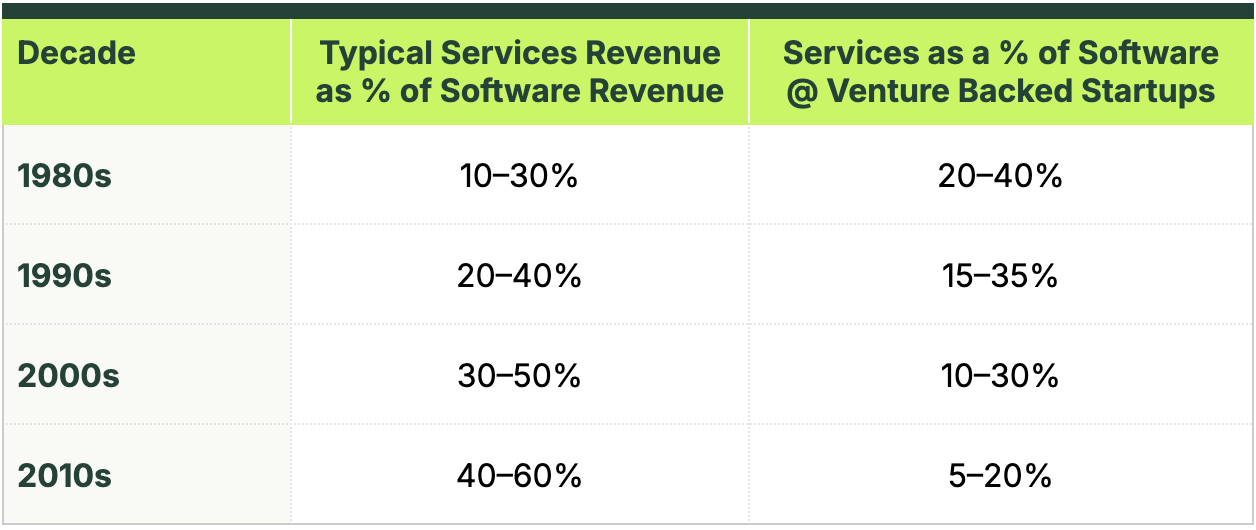
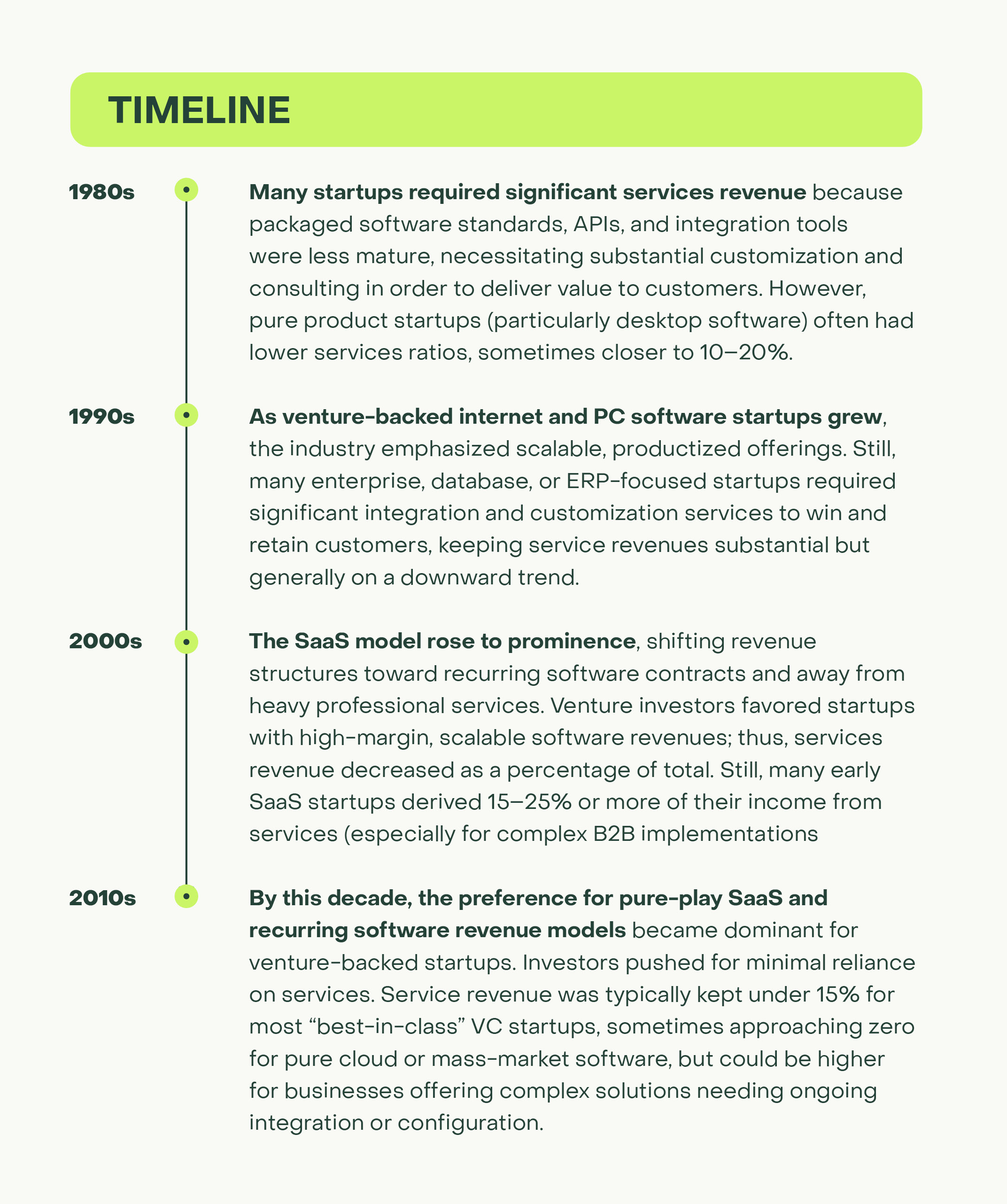
Why the disdain? The logic was simple:
Software licenses were recurring; services were one-and-done.
Software was higher margin; services were people-heavy and lower margin.
Software scaled infinitely; services didn’t.
Palantir’s Contrarian Bet
Palantir broke this orthodoxy. Its ideal customer profile — government, defense and Fortune 500 clients with sprawling, complex problems — demanded hand-holding. The company didn’t wait for customers to self-implement. Instead, it sent in a services team to prove value quickly, then expanded software licenses from there.
This services-heavy motion became core to Palantir’s sales strategy, particularly as demand for its Artificial Intelligence Platform (AIP) surged. Importantly, AI also made those services more productive: fewer engineers could deliver more impact, which boosted margins and reduced the old services drag.
The AI Era: Services as a Growth Engine
Today, every major AI vendor is following suit. Services are no longer an afterthought; they are the bridge to adoption.
Why? Because AI products often touch mission-critical processes. Enterprises won’t risk disruption without guidance. Services teams smooth adoption, accelerate sales, and — with AI-enhanced productivity — no longer carry the same margin penalty they once did.
Why AI Is Failing in Corporate America Without a Services Mindset
The data backs this up. A recent MIT study found that 95% of enterprise AI pilots have failed. Crucially, the reasons weren’t technical limitations, but organizational ones:
The “learning gap”: AI systems often lack integration into workflows, feedback loops, and organizational adaptation.
Overreaching pilots: Too many initiatives try to “swallow the whale” instead of starting with a single pain point and scaling from there.
Vendor-led projects succeed more: Tools purchased from external vendors succeed about twice as often as internally built projects, because vendors scope tightly, manage expectations, and deliver incremental wins.
Taken together, these findings underscore the services thesis: workflow integration, change management, and organizational alignment can’t be solved with an API. They require human-led services that bridge the gap between AI potential and corporate reality.
What Founders Should Take Away
If you’re building a vertical AI application, don’t shy away from services. The old anti-services bias is outdated. Services can:
Accelerate enterprise adoption
Drive meaningful near-term revenue
Deliver healthy margins when paired with AI-enabled productivity
In short: services aren’t the enemy of scale — they may be its best accelerant.
The XRC Angle
At XRC, we see a fundamental shift underway. Services, once dismissed as “non-scalable,” are now a critical part of scaling AI adoption. As venture investors, we’re focused on founders who understand this dynamic — those building platforms where services aren’t a distraction, but a flywheel.
Our portfolio company, Gather AI exemplifies this customer-centric value in a variety of ways. Their solution collects visual data from drones, forklifts, and connected machines; integrates it with warehouse management systems (WMS) and cloud platforms; and uses AI to identify issues and suggest next steps. The platform turns real-world warehouse activity into insight that helps teams meet deadlines, optimize plans, and stay in sync.
Their team physically goes on site with customers to map their warehouse before integrating the solution. It works with any setup, no infrastructure changes necessary, and is offered with off-the-shelf hardware that’s easily deployable and replaceable in 24 hours.
Customers have seen 70% improved inventory accuracy, 75% reduction in cycle counting hours, 90% pallet emergencies reduced and 5X operations productivity.
The next generation of AI companies won’t succeed by software alone. They’ll succeed by combining product with services to deliver adoption, impact, and trust.
Finally thank you for this! I am in High Trust Service Enterprise and needed to see this!!!